
How to get Schufa in Germany #
If you plan to rent an apartment in Germany, you’ll probably need a SCHUFA report most landlords ask for it. SCHUFA, short for Schutzgemeinschaft für allgemeine Kreditsicherung (General Credit Protection Agency), is Germany’s main credit tracking agency. It records your payment history and shows how reliable you are when it comes to paying bills, loans, or contracts on time.
You automatically get a SCHUFA record when you register your address, open a bank account, or sign up for services like internet or a mobile phone contract. Since it takes a little time for your data to appear, it’s best to wait one to two months after moving or signing your first contract before requesting your SCHUFA report.
Unlike in some countries, SCHUFA doesn’t consider your income or job only your financial reliability. So even someone very wealthy could have a poor SCHUFA score if they don’t pay their bills properly.
How to get a free Schufa in Germany? #
Every resident in Germany is entitled to one free SCHUFA report per year. This version, called a Datenkopie (data copy), lets you see what information SCHUFA has stored about you.
To request it, go to the official SCHUFA website, click on “Jetzt beantragen” in the left column, and fill in your personal details. Uploading a copy of your passport and Meldebescheinigung (registration certificate) helps speed up the verification process.
You’ll receive your report by post within a few days. Keep in mind that this free version is for personal use only it’s not suitable to share with landlords or other third parties.
How to get a paid Schufa report #
When you apply for an apartment in Germany, landlords usually ask for the official SCHUFA report, called the Bonitätsauskunft or SCHUFA-BonitätsCheck. This is the paid version that looks more official and is widely accepted for rental applications.
The report costs €29.95 and can be ordered online in just a few minutes. You’ll need to verify your ID using your phone or computer camera most passports work for this. Once verified, you can download the report instantly as a PDF or choose to receive it by post within 1 to 3 days.
If you’re searching for apartments regularly, you might want to try the MieterPlus membership on ImmoScout24. It includes a new SCHUFA certificate every month and other benefits that make it easier to stand out when applying for a flat.
How to get a SCHUFA report instantly? #
If you need your SCHUFA report right away, you can order it directly from the official SCHUFA website. Choose the SCHUFA-Auskunft option, click “Jetzt bestellen”, and fill in your personal details.
The report costs €29.95 and is available immediately as a digital download, so you can use it right away for your apartment application or other purposes.
What is a good SCHUFA score? #
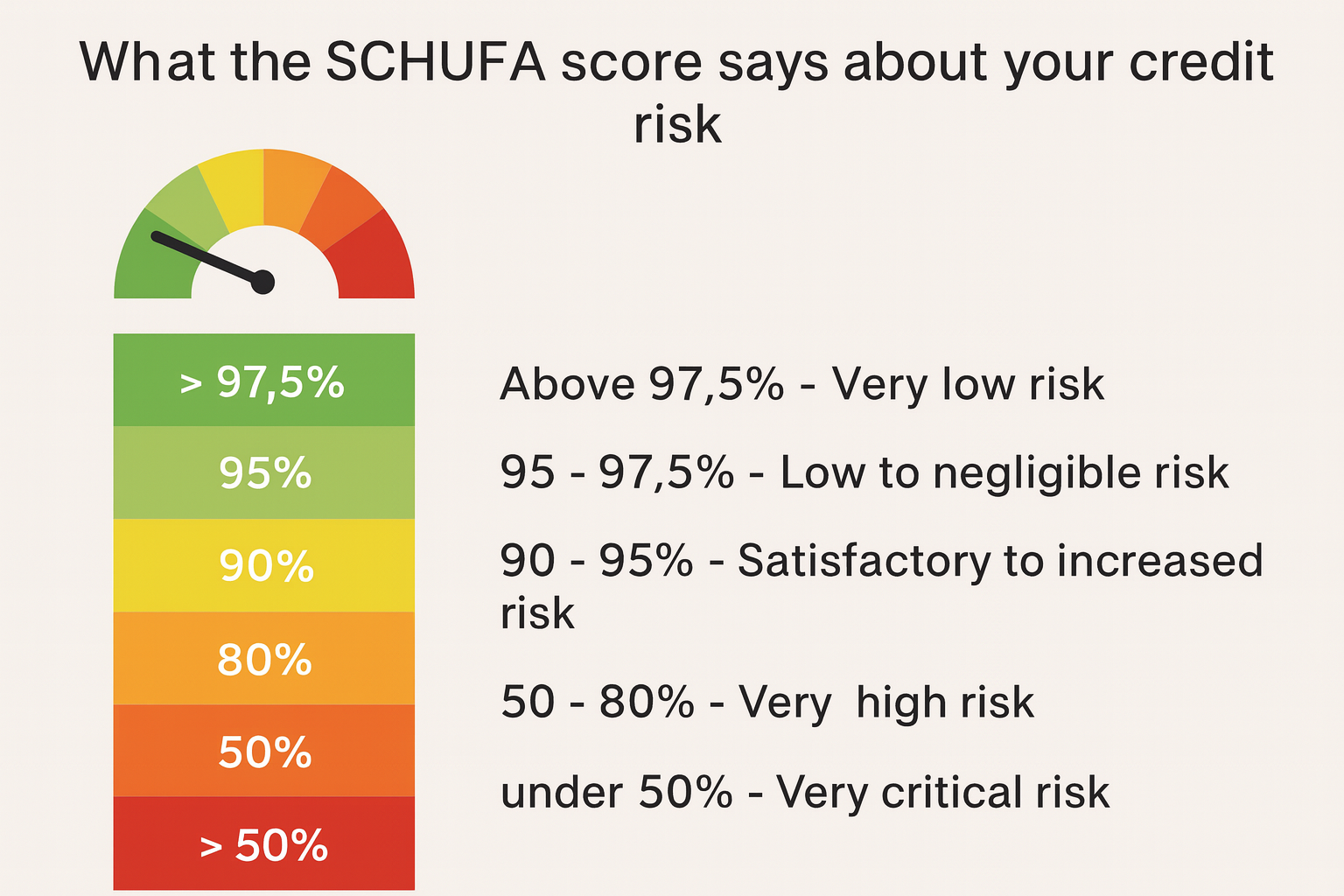
A very good SCHUFA score is 97% or higher, while a good score starts at around 95%. Everyone begins with a Basisscore of 100%, which represents perfect reliability. If you miss payments or don’t settle bills on time, your score will gradually decrease.
Here’s a quick overview of what your score says about the risk of not meeting financial obligations.
How to make better Your SCHUFA credit score in Germany? #
Improving your SCHUFA score takes consistency and good financial habits. Here are some practical steps to help you boost your credit rating:
- Pay your bills on time – Avoiding late payments is one of the easiest and most effective ways to maintain a strong score.
- Limit the number of bank accounts – Having too many, especially inactive ones, can lower your score.
- Stick with one main bank account – Frequently changing banks may negatively affect your credit history.
- Maintain a healthy account balance – Don’t drain your account completely; keeping some funds shows financial stability.
- Keep only the credit cards you use – Too many unused credit cards can harm your score, so cancel those you no longer need.
- Consolidate your loans – Managing a single larger loan is better for your score than juggling several smaller ones.
- Check your SCHUFA report regularly – Use the free annual report to make sure all information is correct. If you spot any errors, you can file an objection and request a correction.
- Resolve negative entries quickly – If a company reports an issue that lowers your score, contact them to settle the matter and ask for the entry to be withdrawn.
- Avoid moving too often – Frequent address changes can also have a small negative impact on your credit rating.
By following these steps, you can steadily build a reliable credit history and keep your SCHUFA score in great shape.
What happens if you don’t have a SCHUFA score yet? #
If you’ve just moved to Germany and don’t have a SCHUFA score, don’t worry that’s completely normal. SCHUFA is a private credit agency, and it only knows what other companies report to them. When you’re new, there’s simply no data about your financial history, so your record hasn’t been created yet.
You’ll automatically get a SCHUFA record once you start doing things like:
- Opening a bank account
- Getting a credit card or loan
- Signing a mobile phone contract
- Taking out private health insurance
- Paying for something in installments
- Or, unfortunately, missing a payment
Usually, your record is created when you open your first bank account in Germany. Your bank checks your SCHUFA status, and if no record exists, a new one is automatically created this process takes about a week.
Keep in mind that not all companies report to SCHUFA. For example, foreign banks or international service providers often don’t use the SCHUFA system, so opening an account with them might not create a record.
Conclusion #
Whether you like it or not, SCHUFA is an important part of life in Germany. It tracks your payment history and helps companies see how reliable you are with money. Your SCHUFA score can affect whether you can get a loan, sign a mobile phone contract, or buy something in installments.
Most landlords also ask for a SCHUFA report when you apply for an apartment to confirm that you pay your bills on time. You can easily get your official report online for €29.95 a small step that can make a big difference when settling into life in Germany.
Check out our guide on what SCHUFA is in Germany to understand how it works and why it matters.
Leave your comment